Market analysis as of early September 2026. This reflects conditions at the time of writing and is for informational purposes only, not financial advice.
EUR/USD enters September sitting inside a broad, well-established range, with the pair having pulled back from a three-month high near 1.1710 hit in late August toward the 1.1600 area as the month closed. With both the European Central Bank and Federal Reserve holding policy meetings just days apart this month, September looks likely to be a pivotal stretch for the pair’s next directional move.
The Current Rate Backdrop
The ECB has held its deposit rate steady since mid-2025, following a run of cuts the year before, and is not expected to move at its September 10 meeting. The Fed, meanwhile, enters its own September 15-16 meeting with hike odds that have risen sharply in recent weeks, following a wave of hawkish commentary from officials concerned about persistent inflation pressure.
This timing matters. If the Fed does hike while the ECB holds steady, the interest rate gap between the two currencies, currently among the more important drivers of EUR/USD, would move further in the dollar’s favor, a dynamic that has historically pressured the euro lower.
Key Resistance Levels
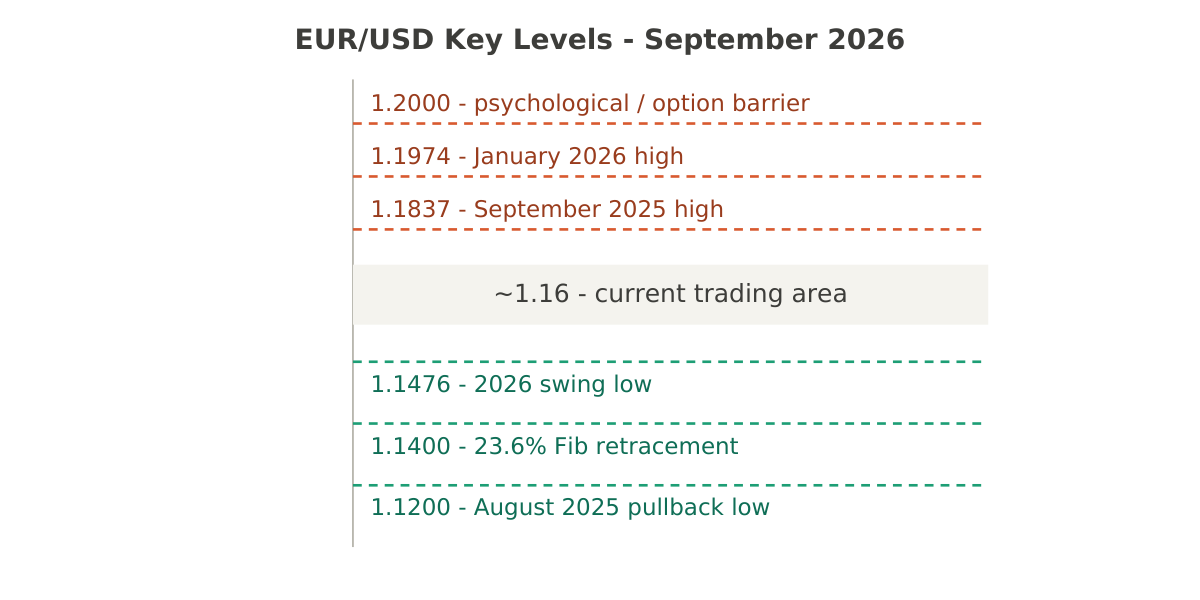
On the topside, 1.1837 marks last September’s high and the first meaningful resistance the pair would need to clear to signal renewed euro strength. Above that, 1.1974 represents this January’s high, and the psychologically significant 1.2000 level sits just beyond, an area that tends to attract heavy option-related activity and can act as a magnet or a wall depending on the broader momentum at the time.
Key Support Levels
On the downside, 1.1476 marks a swing low from earlier this year and represents the first real support level below current prices. Beneath that, 1.1400 aligns closely with a 23.6% Fibonacci retracement of the broader multi-year rally that began in 2022, a level that’s attracted attention from several major bank research desks as a line in the sand for the medium-term uptrend. A more significant break lower would put the pair in view of the 1.1200 area, last tested during a pullback in August of last year.
What Would Shift the Balance
Eurozone inflation has cooled meaningfully, with headline figures dipping below the ECB’s 2% target in recent readings, though core inflation, and services prices in particular, remain elevated enough that the ECB has shown little urgency to cut further. This keeps the European side of the rate equation relatively stable, meaning most of the near-term volatility in the pair is likely to come from the US side of the equation instead.
The US August CPI report on September 11, just days before the Fed’s decision, is likely to be the single most important data point for the pair this month. A hot inflation print would likely reinforce hike expectations and pressure EUR/USD toward the lower end of its recent range, while a cooler reading could quickly unwind some of the dollar strength built up over recent weeks.
How Traders Are Approaching It
Given the proximity of both central bank decisions, many traders are treating the days surrounding September 10 through 16 as a higher-risk window, with some reducing position sizes or widening stops to account for the added volatility rather than avoiding the pair altogether. Institutional forecasts for EUR/USD by year-end remain notably split, ranging from continued gradual euro strength toward 1.20 and above in more bullish scenarios, to a slide back toward 1.10 to 1.14 if the dollar reasserts itself through a confirmed hike and hawkish guidance.
Final Thoughts
EUR/USD’s next major move looks likely to be decided less by any single headline and more by how the ECB and Fed’s back-to-back September meetings unfold relative to what’s already priced in. Keeping the key levels above in view, alongside the September 10-16 event window, should help make sense of whatever direction the pair takes from here.