Market analysis as of early September 2026. This reflects conditions at the time of writing and is for informational purposes only, not financial advice.
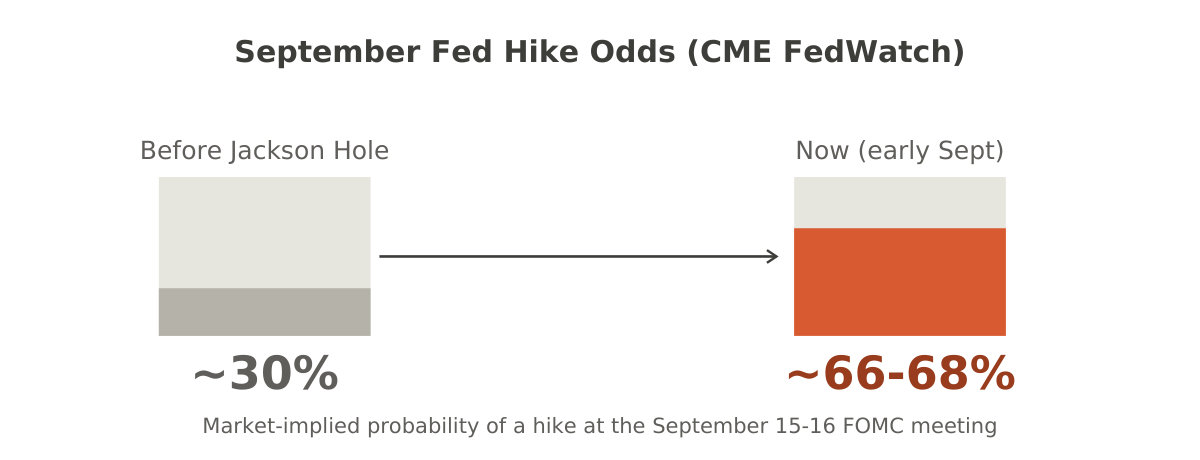
Just a few weeks ago, the conversation around the Federal Reserve’s September meeting was about whether officials would cut rates again or simply pause. That conversation has flipped. Following the Fed’s annual Jackson Hole symposium, a wave of hawkish commentary from Fed officials has pushed the odds of an actual rate hike at the September 15-16 meeting to roughly two-thirds, according to CME FedWatch pricing, up sharply from around 30% just weeks earlier.
What Changed
The shift traces back to persistent inflation pressure that hasn’t cooled the way markets expected. Manufacturing input costs, tracked through the ISM prices paid index, have now risen for 23 consecutive months, a streak that’s hard to ignore even as employment data shows signs of softening. Several Fed officials have since signaled openness to a more decisive response if inflation doesn’t show clearer signs of moderating, a notable change in tone after a year dominated by rate-cut discussion.
The Fed’s current target range sits at 3.50%-3.75%, following three consecutive 25 basis point cuts in the back half of last year. A hike now would mark a genuine reversal in direction rather than simply a pause in cutting, which is exactly why markets have reacted so strongly to the shift in tone.
A Mixed Growth Picture Complicates Things
It isn’t a clean story of an overheating economy demanding higher rates. Recent payroll data has shown real softness, including a downward revision to prior job growth figures. Second-quarter GDP grew at a solid headline pace, but the composition of that growth has kept economists divided on whether the underlying economy is actually strong enough to comfortably absorb higher borrowing costs.
This tension, sticky inflation on one side and a cooling labor market on the other, is precisely why the coming meeting carries so much weight. A hike into a weakening jobs picture is a much bigger and riskier decision than a hike into a clearly overheating economy.
What This Means for the Dollar
In the immediate term, rising hike odds have generally supported the US dollar, since higher rates make dollar-denominated assets more attractive to yield-seeking investors. This has been visible across major pairs, with the dollar firming against the euro, pound, and notably the yen, where the interest rate gap between the US and Japan remains historically wide.
However, currency markets are forward-looking, and a meaningful portion of this hawkish repricing may already be reflected in current exchange rates. The bigger question for traders isn’t just whether the Fed hikes, but whether the accompanying statement and press conference signal more tightening ahead, or frame this as a one-off adjustment.
What to Watch Before the Decision
Between now and the September 15-16 meeting, several data points could shift these odds further. August CPI inflation data, due September 11, will likely be the single most influential release, alongside retail sales figures published the same week as the Fed decision itself. A softer-than-expected inflation print could quickly deflate hike expectations, while another firm reading would likely cement them further.
Traders holding positions into this meeting should be aware that volatility is likely to increase in the days surrounding these releases, with wider spreads and faster price swings than normal, particularly on USD pairs.
Final Thoughts
Whether or not the Fed actually follows through with a hike, the shift in tone alone has already reshaped market expectations heading into September. This is a reminder of how quickly central bank narratives can turn, and why staying close to the economic calendar during a month this data-heavy matters more than usual. Whatever the outcome on September 16, the accompanying commentary is likely to matter just as much as the decision itself.