Published September 7, 2026.
Seven OPEC+ member countries met over the weekend and opted for stability rather than another adjustment, a decision that carries knock-on effects well beyond oil markets and into currencies that move closely with crude prices.
What Was Decided
Saudi Arabia, Russia, Iraq, Kuwait, Kazakhstan, Algeria, and Oman held a virtual meeting and agreed not to make any changes to their output quotas, maintaining September’s production levels through October. This follows a period of voluntary production adjustments among the group, and the decision to hold steady signals a preference for stability over the kind of supply changes that have moved oil prices sharply in past cycles.
Why This Matters Beyond the Oil Market
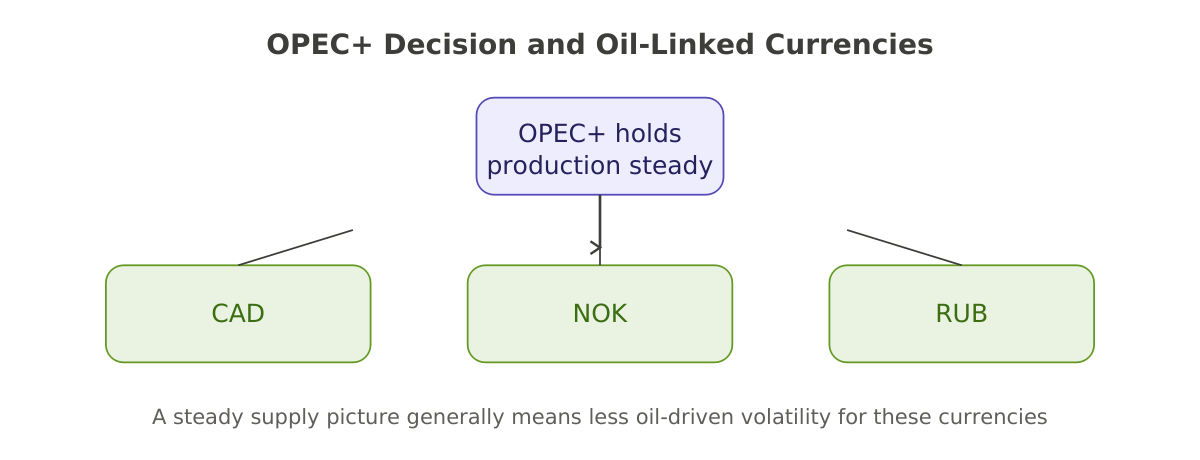
Several major currencies carry a meaningful relationship with crude oil prices, largely because the countries behind them are significant oil exporters. The Canadian dollar is the clearest example among widely traded pairs, given how much of Canada’s export economy is tied to energy. The Norwegian krone and Russian ruble show similar sensitivity, though they see less trading volume among retail forex traders than USD/CAD.
When OPEC+ signals stability rather than surprising the market with a production cut (which tends to push oil prices up) or a production increase (which tends to push prices down), it generally translates into steadier, more predictable conditions for these oil-linked currencies as well, at least in the near term.
The Geopolitical Backdrop Still Matters
OPEC+ decisions don’t happen in isolation from the broader geopolitical picture. Ongoing developments in the Middle East have remained one of the more persistent wildcards for oil markets this year, capable of pushing prices sharply in either direction independent of what OPEC+ itself decides. A hold on production quotas reduces one source of near-term uncertainty, but it doesn’t eliminate the broader geopolitical risk premium that’s been baked into oil prices for much of the year.
What to Watch for CAD Traders Specifically
For traders watching USD/CAD, this production hold removes one variable from the equation, but the pair remains sensitive to several other forces converging this month: the Fed’s own rate decision on September 15-16, Canadian economic data, and any fresh developments on the geopolitical front that could move crude prices independent of OPEC+ policy. A steady oil supply picture generally means CAD’s near-term direction will lean more heavily on interest rate differentials and broader dollar strength than on oil-specific headlines, at least until the next OPEC+ meeting or a significant geopolitical shift changes that calculus.
A Reminder for Traders Newer to Currency-Commodity Links
If you’re newer to trading currencies like CAD, NOK, or RUB, it’s worth building the habit of checking oil market headlines alongside the standard economic calendar. These currencies don’t move solely on their own country’s interest rate decisions and economic data, commodity price swings can move them just as much, sometimes more, particularly following OPEC+ meetings or major supply disruptions.
Final Thoughts
OPEC+’s decision to hold production steady into October is, in market terms, a decision to do nothing dramatic, and for oil-linked currencies, that relative calm is itself the headline. With production stability now in place, the next major catalyst for these currencies is more likely to come from central bank decisions and geopolitical developments than from OPEC+ policy itself, at least until the group’s next scheduled meeting.
This article reflects market conditions and data available as of the time of writing and is for informational purposes only, not financial advice.