Market analysis as of early September 2026. This reflects conditions at the time of writing and is for informational purposes only, not financial advice.
Three of the world’s major central banks are set to announce policy decisions within roughly a week of each other this September, the ECB on September 10, the Federal Reserve on September 15-16, and both the Bank of England and Bank of Japan shortly after. That clustering has put policy divergence, rather than any single data release, at the center of forex positioning heading into the back half of the month.
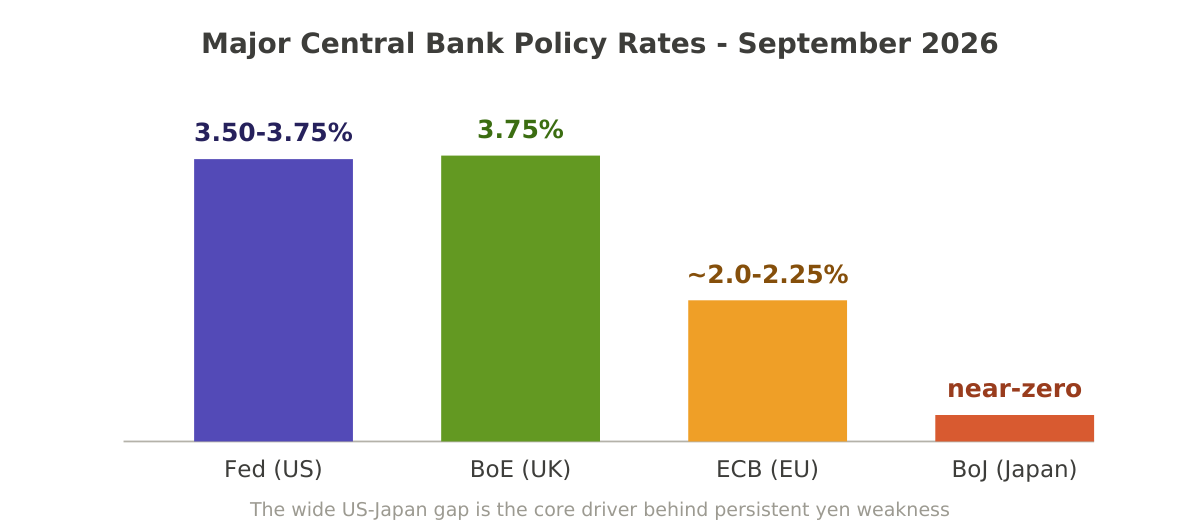
USD/JPY: Testing Multi-Decade Highs Again
USD/JPY has been trading near the 160 level in recent sessions, a zone that continues to test the upper boundary of its range for the year. The core driver remains the wide interest rate gap between the US and Japan, and that gap has actually widened further in the short term as Fed hike odds have climbed.
The more interesting story may be on the Japanese side. Bank of Japan Governor Kazuo Ueda has signaled the central bank will closely reassess inflation risks at its September 17-18 meeting, language markets have read as leaving the door open to a rate hike as yen weakness pushes up the cost of imports. Japanese officials, including the finance ministry, have also stepped up rhetoric about the pace of the currency’s decline, a signal that’s historically preceded direct currency intervention in the past.
For traders, this creates a genuinely two-sided setup: continued dollar strength from a possible Fed hike pulling the pair higher, against the rising chance of a BoJ hike, or even direct yen-buying intervention, capping further upside.
GBP/USD: Supported by a Rate Advantage That’s Nearly Vanished on the US Side
GBP/USD has spent much of the year in the mid-1.30s, a level that reflects how much the traditional dollar interest rate advantage over the pound has closed. The Bank of England’s Bank Rate currently sits at 3.75%, at the very top of the Fed’s own 3.50%-3.75% target range, a historically unusual alignment that has kept cable more resilient than in prior years when the gap favored the dollar more clearly.
That said, the setup carries real event risk this month. The Fed decides on September 15-16, and the Bank of England follows just one day later on September 17. If the Fed hikes while the Bank of England holds steady, that timing mismatch could quickly pressure the pair toward the lower end of its recent range. If the reverse happens, or both banks move in step, the pair could hold its current footing more comfortably.
The Common Thread
What ties both pairs together this month is that neither move is likely to hinge on a single, easily predictable outcome. Each involves a central bank facing its own internal tension, the Fed weighing sticky inflation against a softening labor market, the BoJ weighing currency stability against the risk of tightening into an still-fragile recovery, and the Bank of England weighing its own inflation picture against a slowing UK economy.
How to Approach This Window
With three major decisions landing within days of each other, volatility across JPY and GBP pairs is likely to run higher than usual through the middle of September. Traders holding positions through this period should factor in wider potential price swings and consider whether current stop-loss and position sizing still make sense given the added uncertainty, rather than assuming recent, calmer price action will simply continue.
Final Thoughts
Central bank divergence has been a defining theme in forex markets for years, but rarely have three major decisions lined up in such a tight window. Whatever the outcomes on the 15th, 16th, 17th and 18th, the aftermath is likely to set the tone for USD/JPY and GBP/USD well into the final quarter of the year.