Almost every trading platform offers a demo account, and almost every beginner is told to start there. That advice is solid, but the harder question rarely gets a clear answer: how do you know when you’re actually ready to move to a live account with real money on the line?
What Demo Trading Actually Teaches You
A demo account is genuinely useful for learning how a trading platform works, how to place orders, set stop-losses, and read charts without the pressure of real financial consequences. It’s also a reasonable place to test whether a strategy has any logical merit before risking money on it.
What it doesn’t teach you, and this is the part people underestimate, is how you’ll actually behave emotionally when real money is at stake. Watching a demo trade lose $500 feels almost meaningless. Watching a live trade lose the same amount often triggers a completely different, much harder to manage, emotional response.
The Gap Between Demo and Live Performance
It’s extremely common for traders who look consistently profitable on a demo account to struggle significantly when they switch to live trading, even using the exact same strategy. This isn’t usually because the strategy stopped working, it’s because psychological factors like fear, hesitation, and impulsive decision-making show up in ways a demo account simply can’t replicate.
Knowing this in advance can help set realistic expectations. A rocky transition to live trading doesn’t necessarily mean your strategy is broken, it might mean you need to work on the emotional side of execution.
Signs You Might Be Ready to Go Live
There’s no universal timeline, but a few signals are worth considering. You’ve tested your strategy over a meaningful number of trades, not just a handful of lucky wins, and it’s shown consistent results over different market conditions. You understand exactly why you’re entering and exiting each trade, rather than following signals you don’t fully understand. You’ve practiced proper position sizing and risk management consistently, not just when it was convenient. And importantly, you genuinely understand that demo success doesn’t guarantee live success, and you’re mentally prepared for a possible adjustment period.
How to Ease the Transition
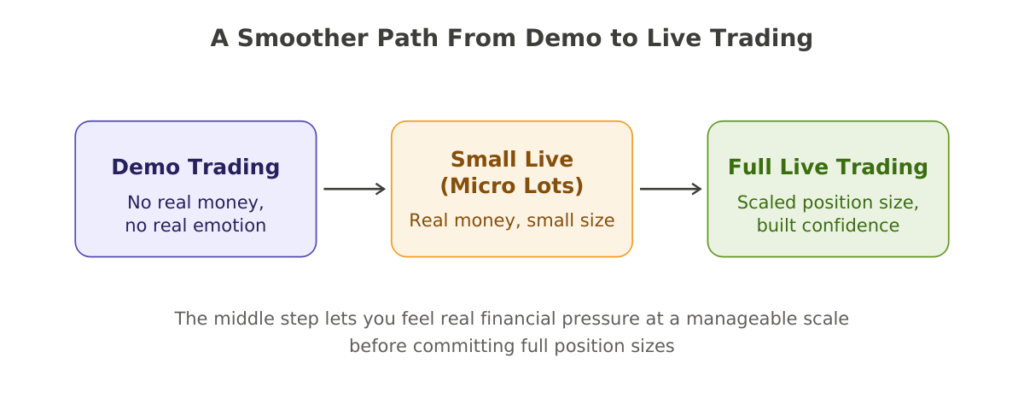
Rather than jumping straight from demo trading to a full-sized live account, many traders find success starting live trading with a very small amount of capital, sometimes called micro-lot trading. The dollar amounts are small enough that mistakes won’t be financially devastating, but real enough that the emotional experience of live trading starts to become familiar.
This bridge period lets you observe your own behavior under genuine (if modest) financial pressure, adjust your habits, and build confidence before scaling up position sizes as your comfort and consistency improve.
A Word of Caution About Demo Trading Too Long
On the flip side, some traders stay in demo mode indefinitely, always waiting to feel “ready enough,” which often becomes a way of avoiding the discomfort of real risk rather than a genuine strategy assessment. At some point, no amount of additional demo trading will teach you what live trading teaches, and an extended avoidance of live markets can become its own obstacle to actual growth as a trader.
Final Thoughts
Demo trading is a genuinely valuable tool, but it has a ceiling. It can teach you mechanics and test logic, but it can’t replicate the psychological weight of real risk. Recognizing that gap, and deliberately easing into live trading with small, manageable size rather than either avoiding it indefinitely or diving in too aggressively, tends to produce a much smoother, more sustainable transition.