It’s easy to think of each currency pair you trade as its own independent bet. In reality, many pairs move in relation to one another, sometimes moving together, sometimes moving in opposite directions, because they share underlying economic drivers. Ignoring this can lead to a portfolio that looks diversified on paper but is actually one large, concentrated bet in disguise.
What Currency Correlation Means
Currency correlation measures how closely two pairs move in relation to each other, expressed as a value between -1 and +1. A correlation close to +1 means the pairs tend to move in the same direction most of the time. A correlation close to -1 means they tend to move in opposite directions. A correlation near 0 means there’s little to no consistent relationship between them.
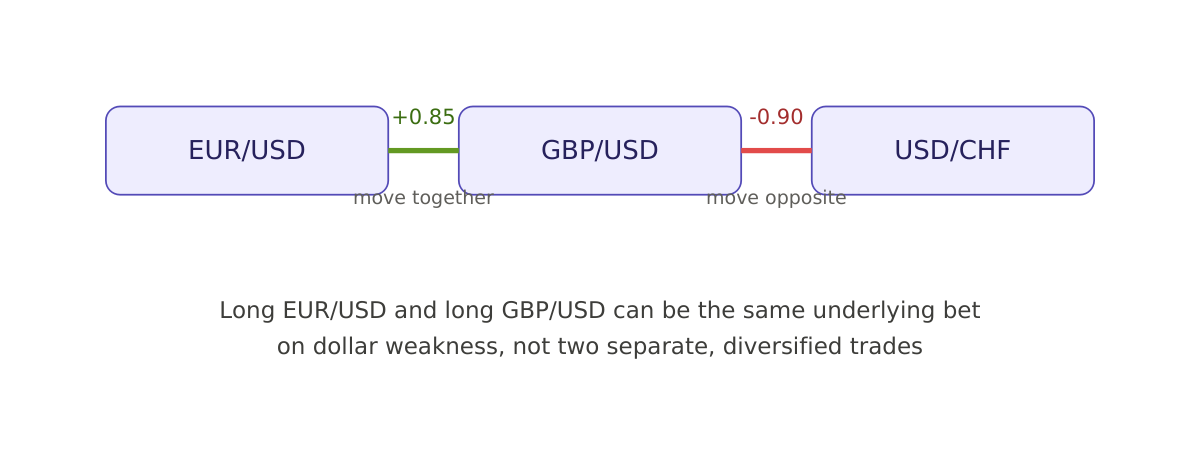
For example, EUR/USD and GBP/USD often show a fairly strong positive correlation, since both the euro and the pound tend to react somewhat similarly to broad shifts in dollar strength or weakness. Meanwhile, EUR/USD and USD/CHF frequently show a strong negative correlation, since the Swiss franc has historically moved inversely to many major currencies against the dollar.
Why This Matters for Risk Management
Here’s the practical problem correlation creates: if you open long positions on both EUR/USD and GBP/USD, thinking you’ve diversified across two different trades, you may actually be doubling down on essentially the same underlying bet, that the US dollar weakens. If that thesis is wrong, both positions can move against you simultaneously, and your actual risk is much higher than it appeared when you were only looking at each trade individually.
This is one of the most common, and least discussed, ways traders unintentionally over-leverage their accounts. They’re managing risk per trade correctly, but not accounting for how those trades interact with each other.
Correlation Can Also Work in Your Favor
Understanding correlation isn’t only about avoiding accidental over-exposure, it can also be used deliberately. Some traders use negatively correlated pairs as a form of hedging, opening positions that are likely to offset each other’s losses to some degree if the market moves unexpectedly. Others use strongly correlated pairs to confirm a trade idea, looking for agreement across multiple related pairs before committing to a position, treating it as an extra layer of validation.
Correlation Isn’t Fixed
An important caveat: correlation between currency pairs isn’t a permanent, fixed relationship. It shifts over time based on changing economic conditions, interest rate differentials, and market sentiment. A pair of currencies that were strongly correlated a year ago might show a much weaker relationship today. This means correlation should be checked periodically, not assumed to remain constant indefinitely.
Many trading platforms and financial websites offer free correlation tables or matrices that update regularly, showing the current relationship strength between major pairs.
How to Actually Use This Information
Before opening multiple positions at once, check whether the pairs involved are correlated. If you’re planning several trades that all essentially rely on the same underlying currency strengthening or weakening, consider reducing your overall position size across those trades, treating them more like one larger position than several independent ones. This keeps your actual account risk in line with what you intended, rather than accidentally amplified by unnoticed overlap.
Final Thoughts
Correlation is one of those concepts that doesn’t show up directly on your trading platform’s main screen, which is exactly why it’s so easy to overlook. Taking the time to understand how your open positions relate to one another adds a layer of risk awareness that goes beyond just managing each trade individually, and it’s a habit that separates traders who understand their true account exposure from those who only think they do.