Leverage is one of the first things that draws people to forex trading, and also one of the first things that gets misunderstood. The idea of controlling a large position with a small amount of money sounds almost too good to be true, and in a way, that’s exactly why it deserves a careful explanation rather than a quick skim.
Let’s break down what leverage and margin actually mean, how they work together, and why respecting them matters more than almost any other single lesson in trading.
What Is Leverage?
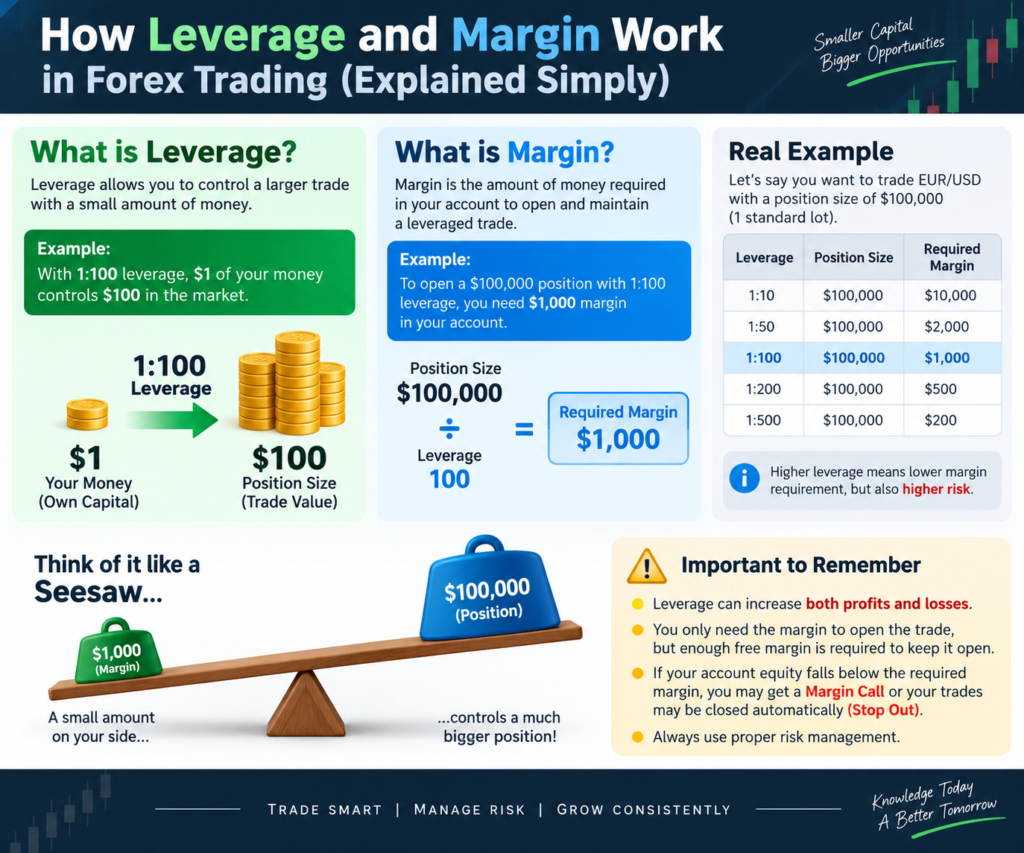
Leverage lets you control a larger position in the market than the amount of money you actually put up. If your broker offers 100:1 leverage, that means for every $1 in your account, you can control $100 worth of currency. Put $1,000 into your trading account, and with 100:1 leverage, you could open a position worth $100,000.
This is why forex trading is often described as capital-efficient. You don’t need a huge account to participate in meaningful position sizes, because the broker is effectively lending you the difference.
What Is Margin?
Margin is the amount of your own money that gets set aside as a deposit to open and maintain a leveraged position. It’s not a fee, and it’s not lost, it’s simply held by the broker as collateral while your trade is open. Once you close the position, the margin is released back to your available balance.
Using the example above, if you’re opening a $100,000 position with 100:1 leverage, your required margin would be $1,000, which is 1% of the full position size.
How They Work Together
Leverage and margin are two sides of the same coin. Leverage tells you how much buying power you get for your money. Margin tells you how much of your money is required to access that buying power. Higher leverage means lower margin requirements for the same position size, which is exactly what makes it both appealing and risky.
Why Leverage Cuts Both Ways
Here’s the part that trips up a lot of new traders: leverage doesn’t just amplify your potential profit, it amplifies your potential loss by the exact same proportion. A 1% move in your favor on a leveraged position might mean a solid gain relative to your margin. That same 1% move against you means an equally sized loss.
This is why accounts using high leverage can gain or lose a significant percentage of their balance from what looks like a small price movement on the chart. The currency pair itself might only move a fraction of a percent, but your account balance can swing dramatically because of the leverage multiplying that movement.
Margin Calls and Stop-Outs
If your open positions move against you enough that your account equity drops close to your used margin, your broker will typically issue a margin call, a warning that you need to deposit more funds or close positions to reduce risk. If the account continues losing and equity falls below a certain threshold, most brokers will automatically start closing positions, often called a stop-out, to prevent your balance from going negative.
This isn’t your broker being aggressive. It’s a built-in safety mechanism, and understanding it in advance is far better than discovering how it works during a losing streak.
Choosing Leverage Sensibly
Just because your broker offers high leverage doesn’t mean you need to use all of it. Many experienced traders use only a small fraction of the maximum leverage available to them, treating the rest as unused headroom rather than a target to max out.
A more useful way to think about position sizing isn’t “how much leverage am I using,” but “how much of my account am I risking on this trade if my stop-loss gets hit.” That question keeps your focus on actual risk rather than theoretical buying power.
A Practical Way to Think About It
Before opening any leveraged position, it helps to ask three questions: How much would I lose in dollars if my stop-loss is triggered? What percentage of my account does that represent? Am I comfortable with that percentage, regardless of how confident I feel about the trade? If the answer to that last question is no, the position is too large, no matter how much leverage your broker technically allows.
Final Thoughts
Leverage is a tool, not a strategy. Used with discipline, it lets you participate in the forex market efficiently without needing a huge amount of capital. Used carelessly, it can turn a small, normal price fluctuation into a serious account drawdown. Understanding exactly how your margin and leverage interact isn’t optional homework, it’s one of the most protective habits you can build early in your trading journey.